






Governor of Central Bank of Egypt and Minister of Agriculture Visit Villages Benefitting from “Transforming the Livelihoods of Smallholder Farmers” Project in Aswan

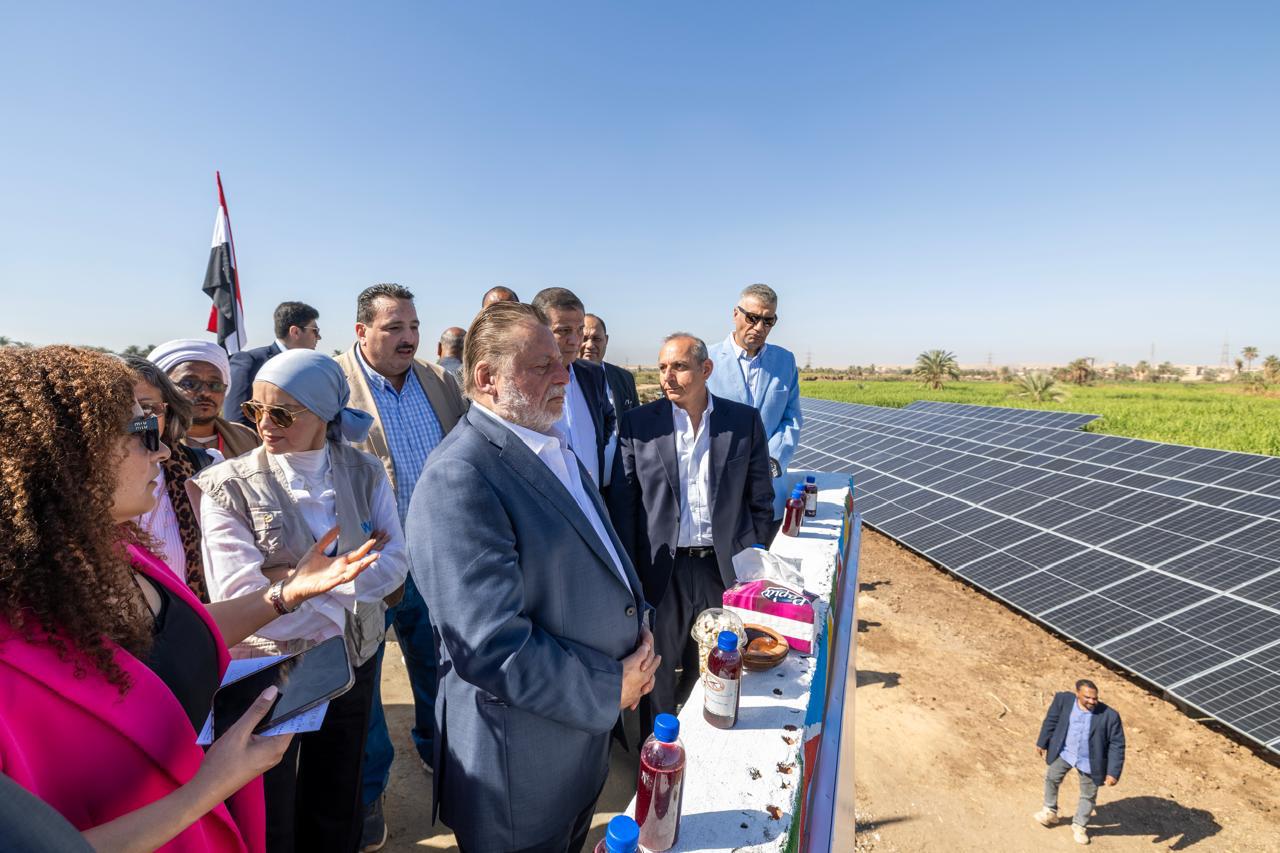
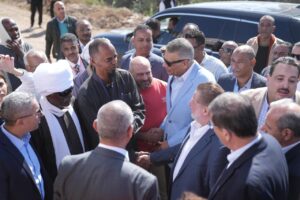
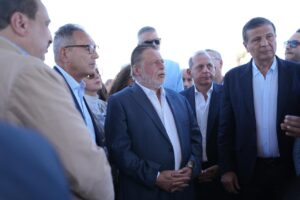
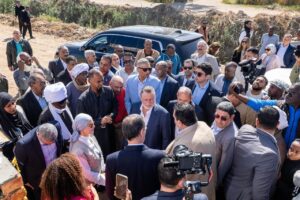
H.E. Mr. Hassan Abdalla, Governor of the Central Bank of Egypt (CBE), and H.E. Mr. Alaa Farouk, Minister of Agriculture, conducted a field visit today in a number of villages within Aswan governorate. The visit focused on sites benefitting from “Transforming the Livelihoods of Smallholder Farmers” project that was launched in collaboration with the CBE, the banking sector, the Ministry of Agriculture, and the UN’s World Food Programme (WFP). The visit included Major General Dr. Ismail Kamal, Governor of Aswan, and Ms. Rawad Halabi, WFP Country Director and Egypt Representative, alongside senior officials from the CBE, the banking sector, and the Ministry of Agriculture and Land Reclamation.
The project is targeting the integration of smallholder farmers into the formal financial system and the provision of tailored financial products and services, with the aim of improving their economic and social livelihoods through the optimal use of land and water resources, along with women’s economic empowerment and financial literacy enhancement.

- Advertisement -
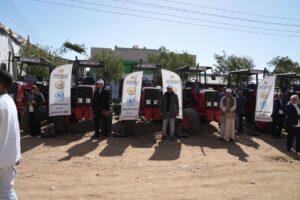
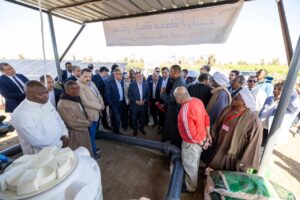
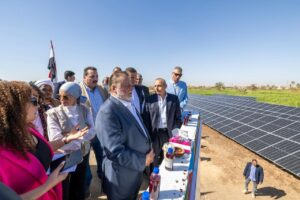
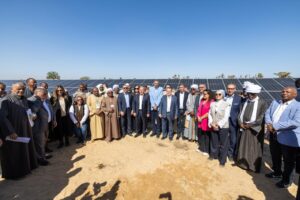
During the visit, their excellencies, the Governor of the CBE and the Minister of Agriculture, visited a solar-powered irrigation station in “Armana” village and reviewed a model for cultivating sugarcane seedlings using solar-powered drip irrigation systems in “Eniba” village. They also held meetings with the projects’ beneficiaries, toured agricultural fields and productive enterprises, and checked the project’s on-ground activities, including the technical and training support offered to farmers, the provision of agricultural inputs, and the promotion of sustainable agricultural practices —all contributing to boosting production and rural household income.

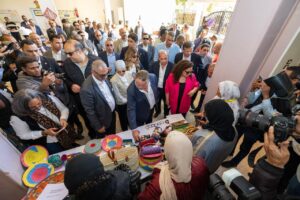
Mr. Abdalla and Mr. Farouk revised the banking sector’s efforts, led by the CBE, to promote financial inclusion across Aswan’s villages, and attended specialized training sessions for women on upcycling palm waste into handicrafts, as well as agri-processing, which included producing energy balls and dates. The visit concluded with a tour of an exhibition showcasing women’s local products, where they praised the quality and craftsmanship of the goods.
On this occasion, Mr. Hassan Abdalla, Governor of the CBE, expressed his delight for being among the people of Aswan, commending their warm hospitality. He also noted that what has been seen on the ground today, of successful models and productive enterprises, reflects the tangible impact of “Transforming the Livelihoods of Smallholder Farmers” project. These outcomes demonstrate effective coordination among state institutions, the banking sector, and international partners in achieving sustainable development in Egypt’s rural areas.
Mr. Abdalla pointed out that the project aligns with the State’s strategy to support smallholder farmers and integrate them into the formal financial sector, while promoting financial inclusion and sustainable agricultural development. This contributes to enhancing citizens’ living standards and optimizing natural resources’ utilization, with a particular focus on Upper Egypt governorates and the most underprivileged areas. He reiterated that the CBE places special emphasis on initiatives that foster the economic empowerment of citizens – with women at the forefront – and the development of rural communities capable of confronting economic and climate challenges.
For his part, Mr. Alaa Farouk, Minister of Agriculture and Land Reclamation, highlighted the Ministry’s belief that smallholder farmers are the cornerstone of food security in Egypt and a key pillar of the national prospect of agricultural sector. He also emphasized the importance of providing them with robust support, underscoring the role of the partnership between the CBE, the Ministry of Agriculture, and the WFP in this regard.

Mr. Farouk further noted that the Ministry’s role is to provide technical and technological support, deliver modern agricultural advisory services, and facilitate access to improved seeds and agricultural mechanization. He added that the goal is to enable farmers to increase productivity and improve crop quality, underscoring that the Executive Agency for the Comprehensive Development Projects (EACDP) – one of the Ministry’s affiliated bodies – will act as the executive arm to guarantee that such support reaches its intended beneficiaries. This will be achieved through the accurate identification of eligible smallholder farmers, effective supervision of project implementation at every stage, continuous monitoring of progress, and the optimal utilization of resources. Mr. Farouk stressed that the support provided by the CBE is a vital source that sustains and empowers smallholder farmers through offering finance from banks, enabling them to purchase production inputs, which are fundamental to shaping and securing the future of farmers and their families.
Within the same context, Ms. Rawad Halabi, WFP Country Director and Egypt Representative, emphasized that “Transforming the Livelihoods of Smallholder Farmers” project is a pivotal milestone in sustainable development trajectory. She noted that the project marks a unique direct collaboration model – under the auspices of the CBE– bringing together the WFP, the Ministry of Agriculture and Land Reclamation, the banking sector, and Aswan Governorate.
Moreover, she pointed out that the model offers innovative tools that provide support through blended finance mechanisms and catalytic capital, aiming to economically empower farmers and enhance food security, in line with Egypt’s vision 2030.
Noteworthy, around 85,000 smallholder farmers benefitted from the project’s first phase, which continued from January 2021 till June 2022. Key achievements included the land consolidation and development of about 8,500 feddans, the introduction of modern irrigation techniques, and the installation of solar panels. Accordingly, a significant improvement was evident in the farmers’ living standards, backed by a 34% increase in crop production and a 35% increase in revenues.
Moreover, the project helped reducing operational costs by 37.5%, supported the capacity building of 50 social and civil organizations, and provided Train of Trainers (ToT) program for 2,250 candidates across all designated villages, with women accounting for 31% of participants. The first phase also offered financial literacy lectures and seminars to around 34,000 beneficiaries, 47% of whom were women, in addition to funding approximately 15,000 women to establish livestock projects, yielding a net income of up to 55%.
Additionally, participating banks offered banking and financial services in the designated villages during the first phase, availing the issuance of “Meeza” prepaid cards and mobile wallets, as well as directing customers to the Business Development Services (BDS) Hubs – affiliated to the “Nilepreneurs” Initiative – for project evaluation and access to necessary funding.
In line with the project’s sustained efforts, the second phase started in January 2025 and will extend till December 2026, with total funding of nearly EGP 120 million, targeting 11 new villages. This phase includes the continued cultivation of strategic crops, the addition of sugarcane, and the planting of selected export-oriented cash crops, such as cantaloupe. In 2025, the initiative supported around 23,500 beneficiaries, while developing and integrating 400 feddans of agricultural land and installing 21 solar power stations with a total capacity of nearly 1,000 kilowatts.


التعليقات مغلقة.